

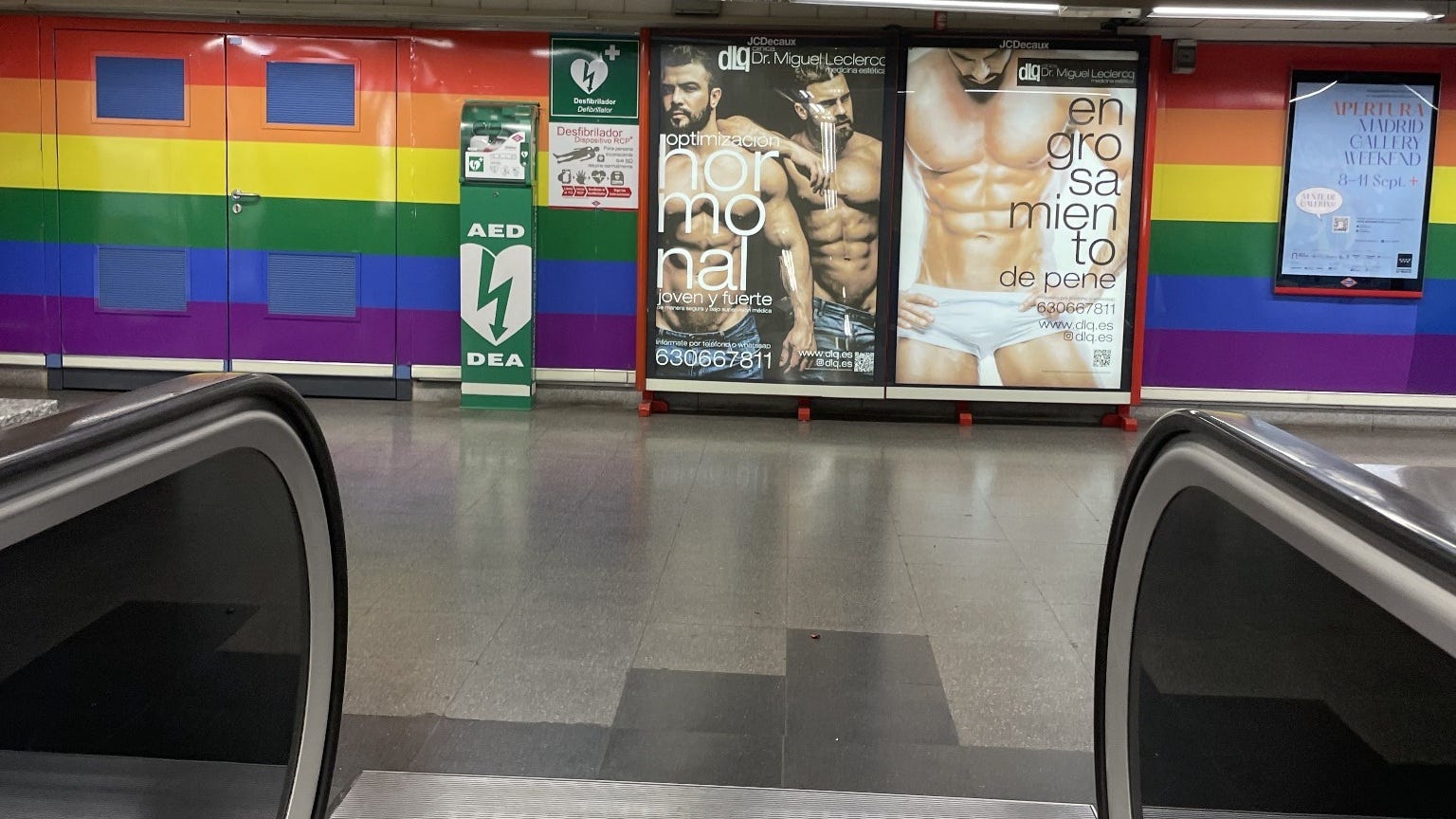
Chueca metro station, Madrid. Photo by Michelangelo Signorile.
Walking the streets of Madrid during Pride month this past summer, I again saw the vibrancy, the audaciousness and the sheer force of the LGBTQ community. The metro station in its gay Chueca neighborhood is permanently awash in rainbow colors, a reflection of the acceptance and visibility the LGBTQ community has achieved in a country where rights have advanced at meteoric speed.
Earlier this year, Spain became ILGA-Europe’s top-ranked country in Europe for LGBTQ rights, surging to number one on the organization’s Rainbow Map. In 2005 Spain became the fourth country in the world where same-sex couples could legally marry. Spain has sweeping protections against discrimination, from jobs to public accommodations. Transgender people, including teenagers, may legally change their gender designation without medical or psychological tests.
While I was there in June, the country’s parliament advanced legislation that would make practicing so-called “conversion therapy” punishable by up to two years in prison, going beyond existing prohibitions and fines. This went in the opposite direction of the U.S. Supreme Court which just months before had ruled against states’ restrictions on conversion therapy for minors.
Yet just over 50 years ago, under the dictatorship of Francisco Franco, queer people in Spain were persecuted, arrested and imprisoned. The regime treated homosexuality as a threat to public morality, subjecting them to police surveillance, incarceration and other forms of repression.
How did Spain move from such brutal persecution to becoming a world leader in LGBTQ rights in such a remarkably short time?
The Signorile Report is largely free and reader-supported. If you’ve valued what you’ve read, consider becoming a paid subscriber and supporting independent, ad-free opinion journalism. Thanks!
Some Americans might attribute it to the horrors of authoritarianism being so fresh in the minds of Spaniards. But it’s more complex.
Over coffee at Madrid’s Reina Sofía museum, an old American friend who has lived in Spain for many years echoed something I’d heard from Spaniards: the Franco dictatorship and its repression haven’t necessarily been taught in depth in Spanish schools. That reflects, in part, the legacy of the pacto del olvido—the “pact of forgetting”—a political understanding that Spain should look forward rather than prosecute the crimes of the dictatorship, in the belief that doing so would help establish a stable democracy.
So the explanation may be less about a collective memory of repression than about what happened when that repression ended. Activists and observers with whom I spoke pointed to something more tangible: Franco’s death in 1975 gave Spain the rare opportunity to create a new democracy, with a new constitution adopted in 1978, just as gay liberation was surging worldwide.
Rather than having to fight protracted battles against established laws, as activists in other Western democracies like the United States often did, LGBTQ activists in Spain could help define what their new democracy would look like.
“Despite all its imperfections, this movement has been capable of acting in a united way,” Ximo Cádaz, a veteran LGBTQ activist who participated in the fight for marriage equality, told me, describing a broad network of LGBTQ organizations. The movement, he explained, has continued to pressure political parties, including from within their own ranks, while forging alliances across Spanish society.
Santi Rivero, a gay member of Madrid’s regional parliament who’s been deeply involved in queer activism, made a similar point about the importance of a powerful, organized LGBTQ movement in such a young democracy.
“They have historically built alliances with unions, with the feminist movement, with neighborhood associations, to make sure they are allies in building rights,” he told me. Spain’s rapid secularization, which diminished the Catholic Church’s once-enormous political influence, also helped create an environment for change.
Spain’s transition didn’t automatically guarantee LGBTQ equality. The movement had to organize, build political power and seize the opportunity. And over the decades, some of its victories have become deeply embedded in Spanish law and society, even as others remain vulnerable to political attack.

That struggle—and the history of repression preceding it—is at the heart of the new film La Bola Negra, directed by Javier Calvo and Javier Ambrossi. Drawing on an unfinished work by Federico García Lorca, the film follows interconnected queer lives across different periods of Spanish history. Watching the film, I was reminded of the importance of remembering—particularly in a country that has tried to put the past behind it.
Because there are always those who would turn back the clock.
Spain faces a crucial snap election on November 29, and several polls show the conservative People’s Party and far-right Vox on course for a combined parliamentary majority. That could bring an end to the government of Socialist Prime Minister Pedro Sánchez, a strong supporter of LGBTQ rights.
Even amid the exuberance of Madrid Pride, political battles were raging. The debate in parliament over conversion therapy was heated, and the right was also attacking the amount of public money going to Pride celebrations.
Both Cádaz and Rivero warned about Vox and the willingness of the People’s Party to accommodate it. It’s a dynamic we recognize in the US, with MAGA and the Republican Party.
Rivero pointed to the rollback of policies protecting trans people in Madrid, some of which had been introduced under the People’s Party’s own regional government. The party, he argued, had now moved backward as the far-right gained strength.
The parallel with the American right’s attacks on transgender people—among the most vulnerable members of the LGBTQ community—is unmistakable.
“We have to recognize that trans people are in a very difficult situation and that we, too, should stand in solidarity with them, just as they stood alongside us in the struggle for everyone’s rights,” he told me. “They were among the first to put themselves on the front lines.”
“There is a perception that certain rights are irreversible—marriage equality for LGBTQ+ people, the right to abortion for women—but that is a mistake,” Cádaz said.
When I interviewed the two activists several months ago, Trump appeared to be at the height of his power, and the American LGBTQ movement was under sustained assault. I asked what advice they would give Americans.
“The United States is the country where the uprisings began that ultimately led to the rights we have today, to the visibility we have achieved in so many countries, and to the social respect we now enjoy,” Rivero said.
There is a striking irony in hearing a Spanish activist speak with such reverence about the American movement, born at Stonewall in 1969, even as he offers advice to Americans on how to defend the rights that movement helped win.
Cádaz stressed the importance of strong organizations, collective action and alliances across society. His message to Americans was simple:
“To resist is to win.”
Rivero offered encouragement, too.
“Take heart. Keep fighting. We have to continue the struggle, and I’m certain that this reactionary wave will come to an end very soon.”
That was before this November’s blue wave in the U.S. crashed ashore, bringing relief and hope for the future. But the lesson from Spain remains: rights are never permanently secure, and the movements that win them must continue fighting to defend them.
I was living in Spain in June 2005 when the PM , Jose Zapatero, made his historic landmark speech in Spain’s Congress of Deputies defending the legalization of same sex marriages & adoption for same sex couples. He withstood massive opposition from the Catholic Church & the People’s Party.
Zapatero was a perfect speech about human rights & suffering.The speech should be a “go to” speech for country leaders and those who oppose rights for LBTQ+. It has always amazed me how Spain transformed from the fascist policies of Franco to acceptance within decades. Italy needs to follow Spain’s transformation. Here is a must see link to Zapaterio’s speech.
https://www.c-span.org/program/international-telecasts/same-sex-marriage-in-spain/144118
Thanks for this really great insight about LGBTQ rights from Spain! I support that very much.
I have been following what’s going on in Span by reading what I can and listening to some of their English language programming from Radio Espana International. What I also see is that Spain is finally coming out of its long Franco dictatorship after 50 years of determined recovery and healing from dictatorship and the trauma dictatorship inflicts on a country. I love this quote from Rivero: “Take heart. Keep fighting. We have to continue the struggle, and I’m certain that this reactionary wave will come to an end very soon.”
We are well on our way to beating back our own reactionary wave of repressive leadership. But…It’s Not Over. We will also have to go through some kind of recovery, healing and shedding of trauma when the Republicans are out. I’ve also noticed by keeping in touch with what’s going on in Spain is that there is a determined sub population in Spain that wants the Franco-type of government back. We are going to have to deal with this kind of reactionary energy too.
It’s Not Over. Now, or even when it might seem to be over in 2028.