

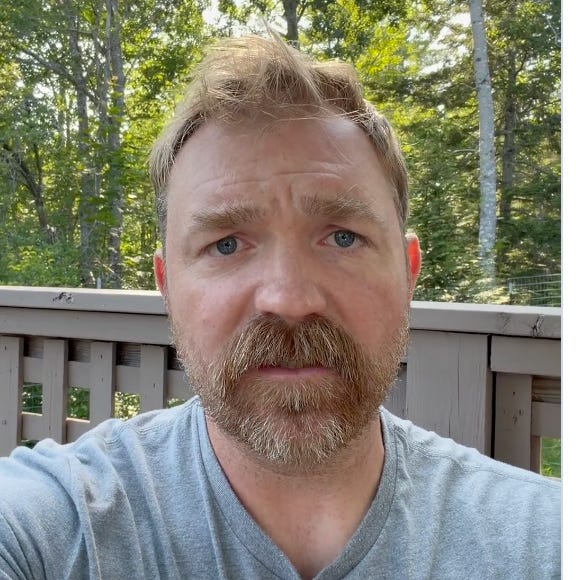
There are many instructive lessons to be learned about the rise and fall of now-former Maine Democratic Senate candidate Graham Platner, who dropped out of the race last night under enormous pressure after a credible rape allegation was made against him. One I want to focus on is how he was chosen, shaped and pruned by political operatives who bear a large portion of the responsibility for what happened here.
One of them at least, Dan Moraff, probably should not work in politics again. This guy allegedly actually tried a few years ago to get a journalist to delete quotes made by a candidate in an already published article because they were too critical of Donald Trump—more on that further down—as Moraff went about his usual behavior of molding candidates into something he thought would sell better to the electorate.
Let me be clear that I’m all for bringing in new and fresh candidates, and we surely need progressive fighters. That is not the issue here. The problem is that the progressive out-of-state consultants who encouraged Platner to run are just as bad as the people in the Democratic establishment who groom candidates with poll-tested talking points and political posturing. Policies and problem-solving for the people take a back seat to winning at any cost.
Last month, after so much had come out about Platner, Moraff told the Wall Street Journal in a video short accompanying a larger piece about him in the paper that he wasn’t worried about Platner’s Nazi tattoo or the vile Reddit posts that had come out at that time. (The meager vetting missed the tattoo but had some of the Reddit posts.)
The Signorile Report is free and reader-supported. If you’ve valued reading The Signorile Report, consider becoming a paid subscriber and supporting independent, ad-free opinion journalism. Thanks!
“Part of our thesis here is that people do not want their candidates grown in vats,” Moraff told the WSJ reporter, alluding to the Democratic establishment, which is risk averse and has been dismally choosing middle-of-the-road, unexciting candidates who are not right for our times. “They want people who are real human beings, and they want people who do not look and sound like the vat-grown people who’ve been leading this country off a cliff for the last century, and that was Graham.”
On the criticism of the Democratic establishment, we certainly agree. And at about the same time as the interview, I defended Platner from the ludicrous attacks coming from Republicans vilifying him as “immoral” while they embrace the rapist in chief, Donald Trump.
But Moraff is just as guilty of creating candidates “in a vat” as the people he’s criticized.
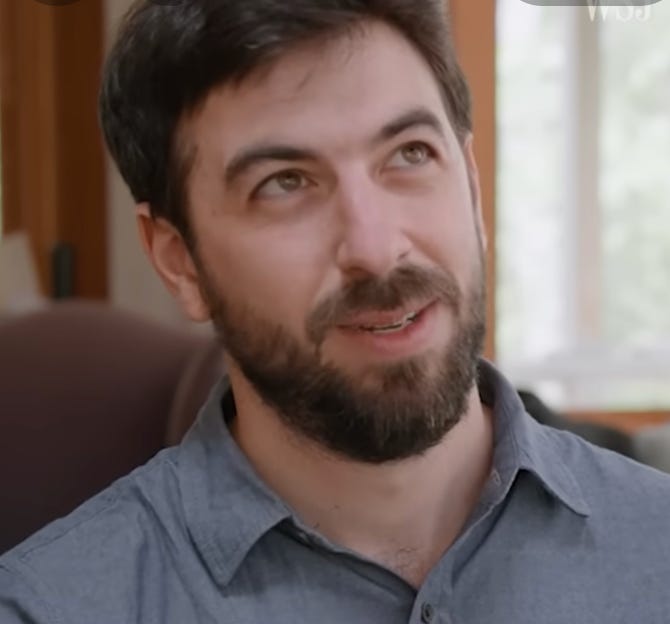
Platner political consultant Dan Moraff, Wall Street Journal video
As The New York Times today describes Platner’s rise, “Last July, in a small town in coastal Maine, a couple of progressive, self-styled recruiters of economic populists showed up at the blue-shingled house of Graham Platner, a little-known oyster farmer and Marine veteran who lived largely off government benefits.”
They had been looking around for a candidate who could take on Republican Susan Collins and were studying quite a few people, according to various reports. They apparently heard about Platner via local activists and had seen a video of him discussing oyster farming. They were taken by the working-class vibe (though Platner is from a wealthy family), the fact that he was a war veteran, his left-leaning politics, and his gruff demeanor. They’d decided they’d found their guy and made the case to Platner, who clearly was enthralled.
The initial headhunters, Dan Moraff and Leanne Fan, and then a third out-of-state operative they called up to Maine — Morris Katz — told Mr. Platner he was “the one,” a “hero of the movement,” “a historical figure” who could be “leading a revolution,” according to half a dozen people with knowledge of their conversations.
But a clutch of people who cared about Mr. Platner were telling him something else. They worried about his mental health, amid his ongoing efforts to heal from post-traumatic stress disorder after tours in Iraq and Afghanistan. They feared this trio of out-of-state operatives was a dangerous combination of inexperienced and overconfident. The worst-case scenario, they thought, wasn’t running for Senate and losing — it was destroying the life he worked hard to build.
Read the boldface text there. I don’t mean to make Platner into the victim here—he’s not, having credibly been accused of raping a woman and having hidden it from his advisers, Democratic leaders, and voters—but it’s clear that he was a very troubled individual who was sold something by a group of people who chose him right out of central casting, getting him all ginned up on the idea of winning a Senate race.
Moraff and his team didn’t do a full vetting, which would take weeks and cost $20,000 per month on retainer, opting for an expedited review that took a few days. They clearly missed a lot.

But this was something Moraff had done before, having come off a string of failures as a strategist. And it needs more attention. After working as a “super volunteer” on Bernie Sanders’ campaign in 2016, and then having an early victory in recruiting progressive activist Summer Lee to run for a state legislative seat in 2018 in Pennsylvania—she won, and then was successful in getting elected as a U.S. House member in 2022—Moraff ran into problems. Per the Wall Street Journal:
Moraff’s backers call him a brilliant disrupter with a fresh perspective who doesn’t mind rubbing people the wrong way to win. But his work for Platner fits a pattern of management of previous campaigns, according to more than a dozen people who have worked with him over the last decade. In particular, candidate vetting has been a frequent source of tension.
In Pittsburgh, the WSJ reports, Moraff “was involved in Turahn Jenkins’s 2018 campaign to take on the county’s district attorney, Stephen Zappala Jr. Less than a week into his campaign, progressive groups backed away from Jenkins when it emerged that he belonged to a church that held antigay views.”
Also in Pennsylvania, Moraff told local journalist Mike Elk that he was recruiting Bryan Pietzrak, a General Electric locomotive factory worker, to run for Congress in Erie in 2022. According to Elk in a piece he wrote this week, Moraff called him while he was out of the country working on a story in Brazil and urged him to remove anti-Trump quotes attributed to Pietzrak from a 2020 piece Elk had written.
Moraff explained at length that Pietzrak’s quote against Trump could hurt his chances of appealing to Trump voters in Erie. I told him deleting a quote as a political favor would violate journalistic ethics. He insisted I do it even after I said no.
Cajoling me, Moraff told me that, “No one would know that I deleted the quote.” I told him that wasn’t the issue, and that it was unethical, so I refused. He told me to forget the conversation and never mention it to anyone. It’s important to know Moraff asked me to lie for a candidate he was recruiting.
In New York, as reported by the WSJ, “Moraff worked as campaign manager for state Senate candidate Debbie Medina. Her 2016 admission that she beat her son as a child with a belt derailed her campaign. The revelation came after older testimony from the sentencing of her son in a murder trial surfaced.” Clearly, another bad vetting issue.
Moraff recruited a candidate in Iowa this year to run for the Senate, Nathan Sage, a veteran and former executive director of the Knoxville Chamber of Commerce. Again, he didn’t do a full vetting, just an expedited one. In this case it appears Sage, who wasn’t getting traction, dropped out in part because Moraff seems to have abandoned him, turning his sights to Maine and Platner, a shiny new object. According to the WSJ:
Sage said Moraff, who showed up at his workplace unexpectedly and convinced him to run, shifted his attention almost entirely from Iowa to Maine once he found Platner. He would sporadically make calls and join meetings only to criticize the campaign’s strategy or offer ideas that didn’t align with Sage’s views and the electorate in Iowa.
Moraff apparently doesn’t delve into policy much, except to tell his candidates “to back Medicare for All and characterize the Israel-Hamas conflict as a genocide,” the WSJ reports, “but beyond that, doesn’t believe voters care about detailed proposals.” For Platner, he apparently crowdsourced policy proposals from activists on Discord, basically just seeing what would play to the crowd.

There’s no question that Chuck Schumer and Democrats in the DC establishment share the blame here, as they refused to draw upon the dynamic candidates in Maine who are now being looked at as Platner’s replacement. They went instead with Gov. Janet Mills, who just didn’t have the fight and wouldn’t bring in younger voters. Few elected officials in Maine then probably wanted to take on the sitting governor the establishment had coalesced around.
This encouraged the very situation we have, in which progressives from out of state came in, did a search, chose Platner, and built support around him. So yes, the Democratic establishment by far isn’t unscathed. But that doesn’t absolve Moraff and his team for the sloppy vetting and for what we would later learn was a disorganized campaign with little money on hand, as Susan Collins had bankrolled ten times more. That is all on them.
And it also shows that they were doing the same thing they accused the establishment of doing: molding a hand-picked candidate, feeding him policy mantras and stage-crafting a campaign.
Not to mention Graham Platners so-called working class roots were as phony as Bob Ritchie's.
I have heard a couple times that Platner and Abdul El-Sayed share the same consultants. If that's true, and Platner's consultants are hucksters, what does that say about El-Sayed's campaign? And am I pinning my hopes on the wrong candidate? If it's El-Sayed against Haley Stevens how can I even vote for Stevens?!?!?!? Everything fucking SUX!!! (NOTE: I did a little more digging and it looks like El-Sayed is not directly connected to Dan Moraff. Of course, they doesn't mean everything DOESN'T suck (smirk))