

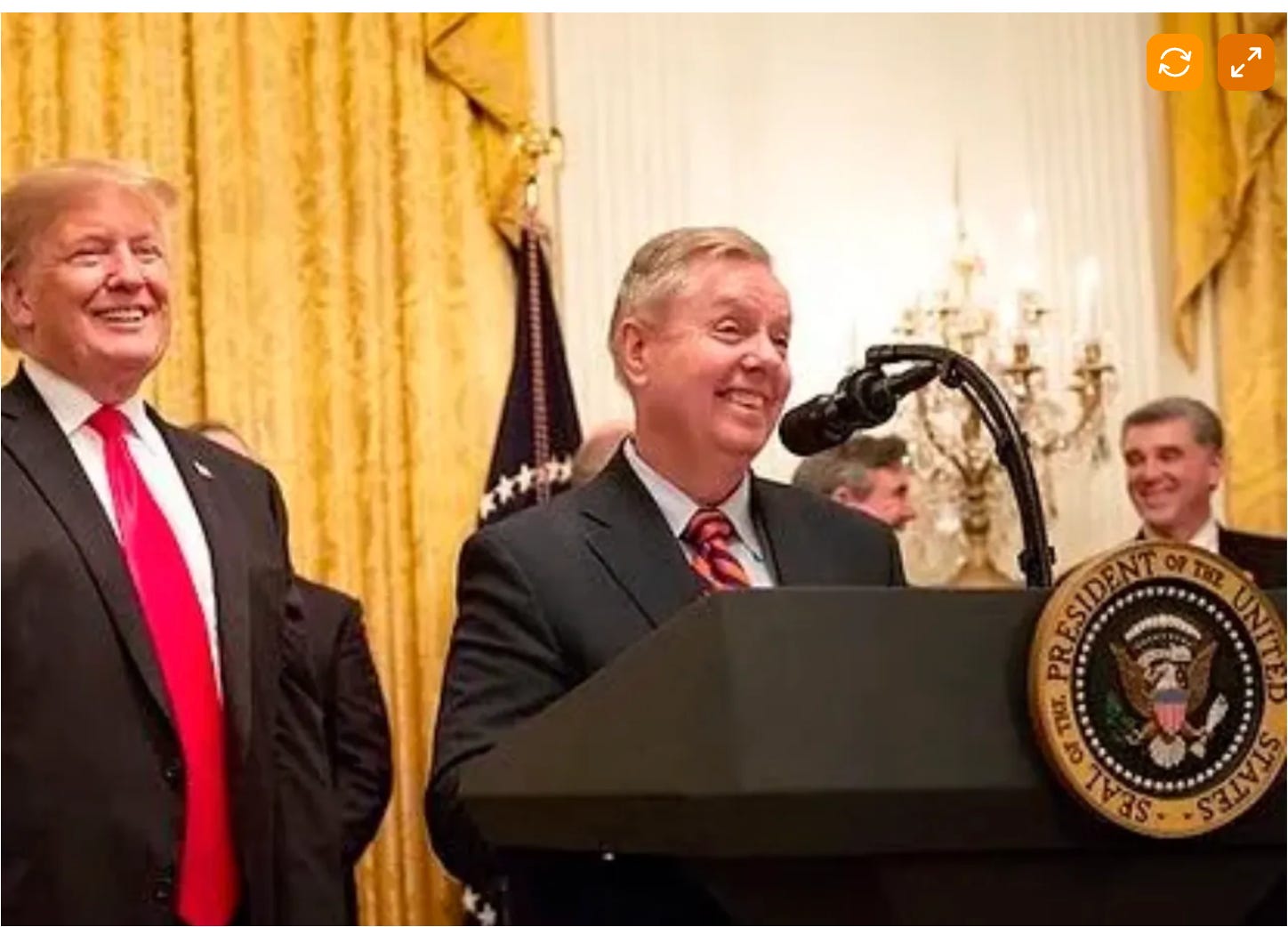
Lots of people responded with a yawn to a 30-minute documentary video released online last week—The “CLOSETocracy”—in which three men claim they were paid for sex by now-deceased Senator Lindsey Graham.
To some extent, I was among them.
I think some of this response was inspired by the way The Young Turks network, which released the film, oversold it.
“We’re going to drop a bombshell documentary tomorrow morning called The Closetocracy,” TYT founder and host Cenk Uygur wrote on X. “Which US Senator did we catch using male escorts?” This implied, in the middle of a contentious election season that has us gripped by the here and now, that the senator in question was still alive, sparking all kinds of speculation.
The Signorile Report is free and reader-supported. If you’ve valued reading The Signorile Report, consider becoming a paid subscriber and supporting independent, ad-free opinion journalism. Thanks!
Was it Ohio GOP Senator Bernie Moreno, who was embroiled in a gay scandal in 2024 over a 2008 profile on an adult site seeking “Men for 1-on-1 sex” that was, as reported by the Associated Press, connected to his email account—and which surfaced again recently? Was it Arkansas GOP Senator Tom Cotton, about whom there have been unconfirmed rumors and lots of chatter in online spaces for years, even among conservatives back in 2023? Or was it Josh Hawley, who, based on an unsubstantiated report, was claimed to have been kissing a male date? Surely, any of these would be a “bombshell.”

But no, it was tired old Lindsey Graham, about whom we’d heard stories and rumors for ions—as had seemingly everyone in Washington—with the speculation surfacing in the media several times over the years. And it was coming at a time when we’re consumed with the still-living Republicans who are voting against us and who back Donald Trump and his authoritarian agenda as we face the midterm elections.
My first reaction was actually frustration that the men had not come forward while Graham was alive, still standing by his horrendous anti-queer record while denying that he was gay. But people have to make their own decisions about speaking out, and one of the men in the film, Cory, had actually spoken out in 2020, using his porn name of Sean Harding, lighting up Twitter and speaking about his and other male sex workers’ interactions with “Lady G.” He soon faced violent threats against him and his family and disappeared from social media.
It’s fair to wonder what good it does now that Graham can’t be forced to respond and his backers can’t be forced to defend the vile anti-LGBTQ movement they’ve fostered. Nonetheless, it’s still a major story that raises questions about the closet in Washington and the dangerous combination of the closet and power, something I’ve been reporting on for over 30 years as a journalist.

It took me back to my first book and all of the controversy surrounding it, 1993’s Queer in America, in which I reported on closeted Washington politicians, including senators, who voted against gay rights. Their secrecy left them compromised, open to blackmail at a time when exposure could certainly destroy their careers. It had them voting anti-gay, overcompensating as they trembled in fear. And it also had them harming those who worked for them, with some engaging in male-on-male sexual harassment in the workplace, because it was one of the few ways they could pursue sex or some semblance of intimacy, unable to live openly.
When politicians are lying—Graham repeatedly said he was not gay—and voting in a hypocritical manner, it should be big news. Graham voted against repealing “don’t ask, don’t tell” while he himself served in the military amid longstanding rumors about his sexuality. He opposed marriage equality, bowing to Christian nationalists in the GOP base. It’s still news even when allegations about a senator emerge after his or her death, as investigating them can correct the historical record and expose a larger pattern. And it raises questions about how many more such closet cases there may be who are working against LGBTQ people.
To its credit, The New York Times reported on The CLOSETocracy last week, even as other major news organizations haven’t yet covered it, and the story goes through the important details:
A video released on Thursday by a left-wing online news channel features three men who claim that Senator Lindsey Graham, the South Carolina Republican who died suddenly in July, paid them for sex.
In the 30-minute video released by the Young Turks network, titled “The CLOSETocracy,” one man who identifies himself only by a first name, Kelvin, claims that Mr. Graham paid him for sex when he was 17 and surreptitiously taped him during the encounter.
Another man said he was picked up by a chauffeured car that delivered him to the Mayflower Hotel in Washington, where he said he was paid to have sex and spend the night with Mr. Graham. That man, who is identified in the film as Cory, said he did not realize it was Mr. Graham until months later when he recognized the senator on television during the 2016 presidential race.
A third man said he was paid to have a sexual encounter with Mr. Graham.
Yes, Cory says he was a minor, 17 at the time, when Graham paid him for sex. In the film, he describes Graham as apparently figuring out he was under 18—though Cory denied it—and anguishing over it but still going along with the encounter, taping him claiming he was 18.

If true, this itself would tell us a lot—again, how a closeted, powerful politician who fears exposure within his homophobic party might go to great lengths, even possibly committing a crime, in order to have intimacy because he sees no other choice, not with the closet he believes he has to protect at all costs. I’ve always hated the word “outing,” and just see it as “reporting.” Public figures’ lives are open for dissection by the media and, when it’s relevant, their sexual orientation should be reported on, just as their religion, their gender or any other aspects of their lives are reported on when relevant.
Had Lindsey Graham’s sexual orientation been investigated and documented early in his career by the media, perhaps the alleged encounter with a minor might not have happened. And perhaps we wouldn’t have had a closeted senator voting against LGBTQ rights.
And that gets me to not giving The New York Times too much credit. True, it reported on the video last week, which is light-years from when I reported on business tycoon Malcolm Forbes’ homosexuality after he died in 1990—and it took The New York Times (unlike other news media at the time) almost six years to acknowledge it, and only in the context of his son, Steve Forbes, running for president.
But the paper—and all of the media—could have investigated Lindsey Graham’s denials decades ago. It’s clear to me that Washington reporters, like the rest of us, had heard the stories for many years. Yet they thought it was an “invasion of privacy” to go there, even as he was harming the community. It shows how much they still are squeamish and fear the backlash, and don’t see the LGBTQ community as a priority or certainly something worth risking an attack over.
So, on the one hand, we’ve come pretty far if the revelation about a dead senator could be met with a yawn by many. But on the other hand, we’ve not come nearly far enough if closeted public figures are still considered an open secret but not worthy of being investigated and reported on while they are alive.
The other issue is Graham's sexuality could and probably was something that trump held over LG's head. In this sense, Graham was a huge security risk, not that he was gay but the lengths he would go to to stay in the closet.
Love your writing.
Open secrets are tolerated within the family if they are never exhibited publicly and embarrass its members. I see the Republican Party as a big, extended Southern family in a very Faulknerian way.
The damage done by the secrets and lies are passed on for generations so there is never accountability and healing.