

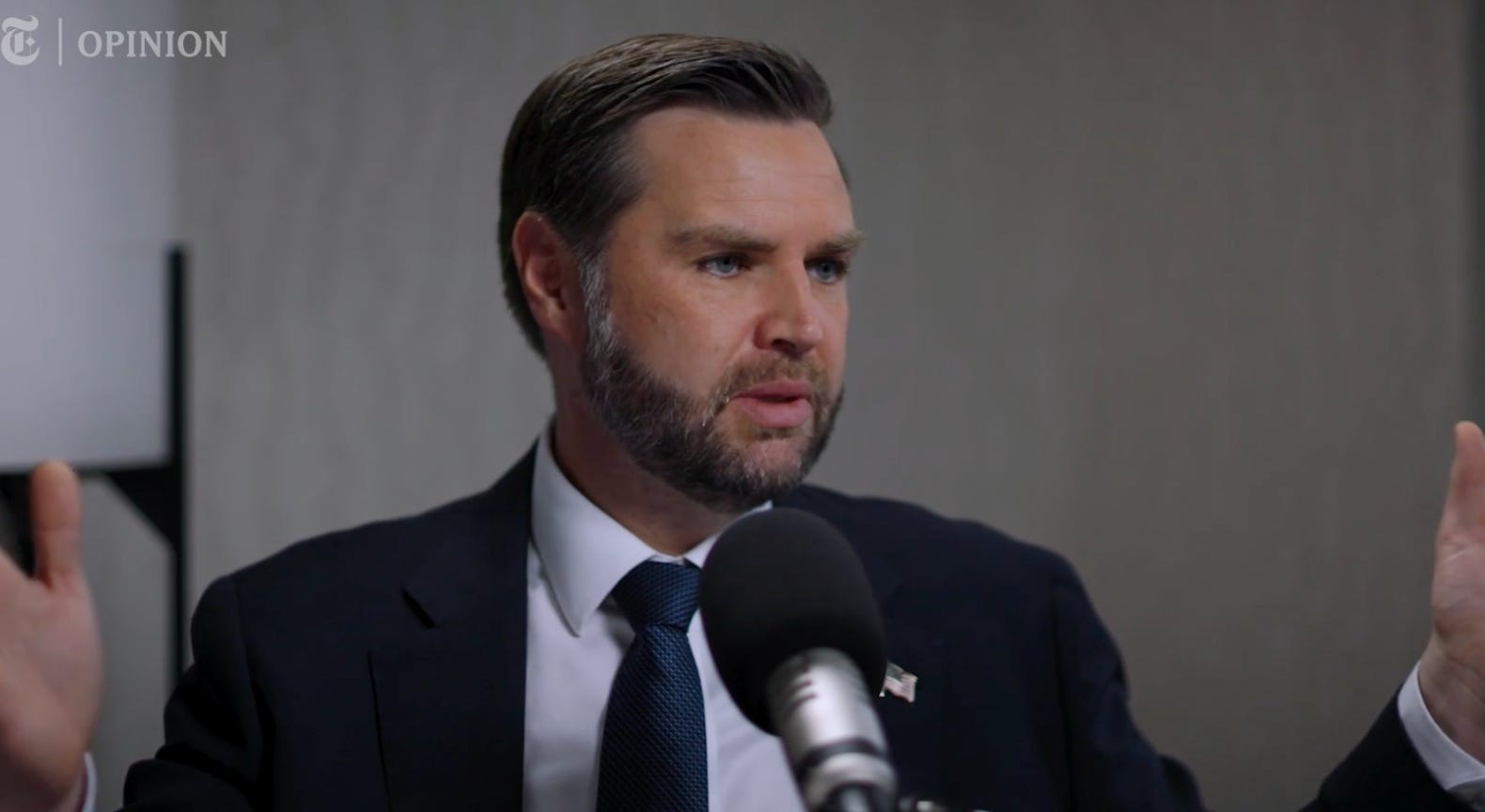
When JD Vance hasn’t been failing in peace talks to end the Iran war, he’s been spending his time going on talk shows to promote his book, “Communion,” all about his conversion from Protestantism to Catholicism.
How he has time to write a book as vice president—and how appropriate that is, considering vice presidents have rarely done so—is another story. This is a book that, like all aspiring presidential candidates, is about setting Vance up to win the highest office in the land, a pretty scary prospect.
On the book itself, I leave it to the scholar Anthea Butler, a professor of religious studies and Africana studies at the University of Pennsylvania, who teaches about religion and theology and notes, “Vance’s new book ranks among the worst things I’ve read.”
As has been reported, there’s a United Methodist Church on the cover of this book about converting to Catholicism, and that choice of illustration serves as a metaphor for the ignorance and inauthenticity found within…
Vance appears to be bringing some of his evangelical upbringing and theology to his Catholic faith…That’s why, despite his conversion to Catholicism, Vance still comes across like an evangelical. His willingness to argue Catholic theology, despite his limited knowledge, speaks to his Protestant upbringing..
What I’m going to address more specifically is Vance’s discussion about the book with Ross Douthat, the right-wing New York Times opinion columnist. Douthat, like Vance, converted to Catholicism from Protestantism and has similarly criticized the pope and Vatican teaching. So these are two odd peas in a precarious pod.
The Signorile Report is free and reader-supported. If you’ve valued reading The Signorile Report, consider becoming a paid subscriber and supporting independent, ad-free opinion journalism. Thanks!
Douthat, to his credit, does sometimes ask Vance about contradictions in his writing and thinking when it comes to his conversion to Catholicism. But he too easily lets Vance off the hook when the vice president offers a completely unacceptable answer.
A duplicity on ‘culture wars’
Vance claims in the book, and to Douthat in the interview, for example, that the seeds of his conversion to Catholicism began as he saw conservative Christians focused on the Terri Schiavo case, the woman who, in 1990, was in a vegetative state after cardiac arrest and whose parents battled her husband against taking his wife off of a feeding tube. It was a non-stop media story and a battle between Christian nationalists (including evangelicals and conservative Catholics) and the rest of us.
Vance said this overblown “culture war” issue, like others that are often used by religious fundamentalists to gin up the base and raise money, didn’t speak to him and his life experience as a young man who enlisted in the Marines straight out of high school and was a combat correspondent, a military journalist:
I was about to leave for Iraq. My entire family was terrified that something bad was going to happen to me. My mom was struggling with the worst throes of her addiction problem. My grandmother had just died.
Our economic situation in our family had been bad for a long time. Now it seemed to somehow get worse. And I’m sending money back home to my family and thinking to myself: This Christianity has nothing to say about the struggles in my life.
Vance goes on to say that “it’s important for Christian churches to recognize that there are a lot of kids—whether they’re at college or they’re in the workforce—they’re living the normal struggles of life,” adding that they’re “dealing with heartbreak, they’re dealing with addiction in their family, maybe they’re struggling to find a job.”
Where to begin with this?
First off, why didn’t Douthat ask him why, then, do he and Trump and the religious conservatives of the MAGA base focus obsessively on transgender issues, for example, another “culture war” issue that is completely divorced from the experience of most Americans—including young men struggling with addiction or going into the military—who really couldn’t give a damn about the focus on the issue, which serves to harm a minority group while it gins up the religious right base and raises funds for it?

Secondly, if that was the reason for his conversion, why is he pining for a pope who is more actively involved in such “culture war” issues, seeming to believe Pope Francis was too liberal and that Leo is following in his footsteps?
What about MAGA’s love of immorality?
Douthat at one point gets Vance to admit that, in Douthat’s words about the book, “you’re offering [religious life] as an alternative to a kind of male nihilism.”
“Sure,” replies Vance. So Douthat goes in for what could be the kill.
“You talk about when you were in your 20s, that was the culture of pickup artists, and ‘The Game,’” Douthat says. “But now I think you could say it’s kind of metastasized into a culture of male influencers who have big doses of misogyny, sometimes racism and antisemitism, a whole spectrum from Andrew Tate to Nick Fuentes. What is the best response to that culture? Do you want to proselytize to young men in those worlds about the path that you took?”
A perfect setup, right? I mean, how on earth do Andrew Tate and Nick Fuentes, both embraced by MAGA to one degree or another—Tate having been helped by the Trump administration to evade a Romanian travel ban after he’d been arrested in that country for human trafficking and the white supremacist Holocaust denier Fuentes having dined with Trump—embody the morality of Catholicism?
Vance replies, “No. I’ve never thought of myself as proselytizing to really anybody.” Douthat gingerly says, “but you’ve written a book that’s offering a model.”
But then Douthat lets Vance change the subject to his wife, Usha, and their marriage, rather than stating what I just did above about Tate, Fuentes, Catholic morality, and the MAGA agenda Vance embraces.
Mass deportations as God’s work
On immigration and mass deportations, as well as humanitarian aid around the world, Vance is absurdly allowed by Douthat to claim the administration’s policy is very Christian and is rooted in Catholic theology after Douthat suggests the MAGA “tone” is not Christian.
“The administration has been more hostile than any prior Republican administration, to say nothing of Democrats in the last 20 years, to the way we do humanitarian aid,” Douthat says.
Vance claims that on foreign aid and immigration, however, the administration is thinking about the Americans who are supposedly hurt by our spending money on foreign aid and by our not keeping out immigrants.
The pope—whom Vance unconvincingly tries to claim he has a good relationship with, even though he’s lectured Leo on theology—and the Catholic Church do not pick and choose between different humans when talking about helping those in need. So this is just a bonkers argument. Humanity is humanity as far as the pope goes.
“Take a classic example,” Vance says. “The Biden administration had a very humane way of talking about immigration, about illegal immigration. It was very charitable in some of the words that it offered to people who were coming into our country. I would say that it was not particularly charitable to the people who were living with the consequences of mass migration into our country.”
Pure rubbish and completely fraudulent. Need I point out that the major “consequences” of immigration have been a boon to the economy, workers doing jobs Americans don’t want to do, more money in Social Security (which immigrants don’t receive back), billions in tax revenue from workers, and much more?

Douthat lets Vance get away with it. I could go on regarding these kinds of claims on Trump policy and Vance lecturing the pope on theology. But one other issue Vance brought up that galled me and which Douthat didn’t challenge in the slightest was the idea that people brought up with religion are somehow more well-adjusted.
Making kids “take” to religion
Vance noted that he takes his children to church—his three children whose mother, Usha Vance, by the way, is Hindu, but he never explains this—and has a “fear” that it “won’t take.” Then he says:
I think the evidence is quite clear that people and families that are raised with some sort of institutionalized faith are happier and healthier and more well-adjusted.
This again is a wild claim, and Douthat clearly agrees and lets it go. For any study that can show the benefits of religion in upbringing, one can produce a slew that show the opposite. One 2015 study found children raised in religious families are meaner, “less kind and more punitive than those from non-religious households.”
I know that most of us who are queer and grew within faiths that have condemned homosexuality—which are the majority of denominations in the U.S. over the last century—suffered psychological abuse. And while Catholic theology—the Vatican’s doctrine—has a long way to go, both Pope Francis and Pope Leo have now recognized this, having reached out to the LGBTQ community, having called for less of a focus on sexual morality, having allowed for the blessing of gay unions, and having reshaped the American church with more inclusive leaders.
Neither Douthat nor Vance got into any of this, nor did they discuss how Vance is following tech billionaire Peter Thiel, who groomed him, funded him, and placed him where he is after Vance worked for him as a venture capitalist in Silicon Valley. Thiel bankrolled Vance’s campaign for the Senate, brought him to national prominence, and lobbied Trump to choose him as his running mate.
As Anthea Butler notes of Vance’s writings in his book, “It’s the Catholicism of Peter Thiel, the PayPal founder and Republican megadonor who has recently been lecturing on the antichrist, that appears to attract [Vance] most. ‘Possibly the smartest person I’d ever met,’ Vance writes of Thiel; ‘he openly identified as a Christian. He defied the simple social template I had constructed—that dumb people were religious and smart people were atheists.’”
Some observers have noted that Thiel (who actually hasn’t converted to Catholicism though he draws upon it) is not really interested in Catholicism or religion. He’s interested in politics and power. He knows that the Christian right will be a force in the GOP for many years, won’t trust anyone who doesn’t profess faith and is obsessed with the idea of the antichrist. Many see Thiel’s secret, off-the-record lectures on the antichrist as a tool to connect the high-tech world, a science-based, libertarian one that has not traditionally been immersed in religious faith, with religious fundamentalists, all for the sake of politics.
In other words, it’s a fraudulent Catholicism used as a tool to gain power, just like that of his puppet, JD Vance.
Although I am an ex-Catholic, 12 years of Catholic schools left its mark on me to be kind to others, feed the poor, and be honest with myself and others. I see nothing in JD that resembles Christian/Catholic teaching. The Pope is a good leader. He doesn't have time for idiots like Trump and Vance.
Funny how the supposed relief to be had for Americans from the expulsion of our immigrant neighbors has ended up in the pockets of rich folks and corporations, rather than feeding, housing, or providing for those citizens in need. Almost as though the premise was a lie from the start.